
Home / Guides / Open Cell vs Closed Cell Foam
Open cell vs closed cell spray foam: how to tell what is in your loft
The open cell vs closed cell spray foam question has one practical answer: open the loft hatch and press it. One gives under your thumb like a sponge. The other is hard, and it is the one that makes the removal job longer.
Free spray foam removal quote
No obligation. We will take a proper look.
The quick way to tell them apart from the loft hatch
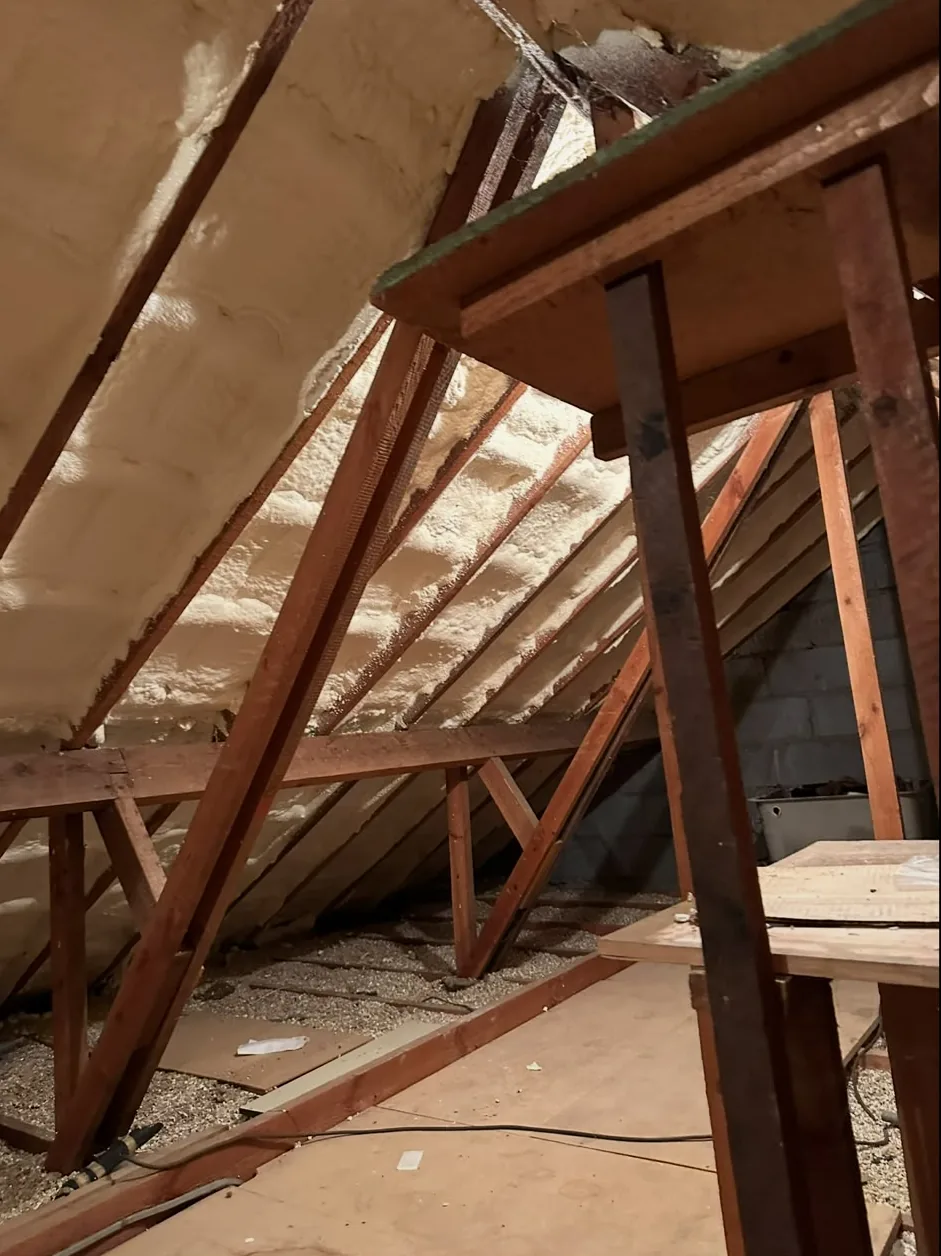
Press it with your thumb. Open cell gives, springs back, and feels like a firm sponge or a bath mat. Closed cell does not move at all, and tapping it sounds solid rather than hollow. Look at the surface as well. Open cell is often sprayed thick between the rafters with a soft, torn, uneven face, and the rafters stand proud of it. Closed cell is sprayed thinner, sets with a harder skin, and is frequently taken straight over the rafters so the timber disappears underneath it.
The other tell is the underside of the tiles. If foam is bonded directly to the back of the tiles or slates with no felt visible anywhere, it is almost certainly closed cell, because that is how it has been sold and applied. If an old felt layer is still there behind the foam and you can see it sagging between the battens, open cell is the more likely one. Do not cut into it to find out and do not pull at it. Take a photograph instead.
What open cell foam is and how it behaves
Open cell foam is a low density polyurethane with a cell structure that is not sealed, so air moves through it and it holds very little rigidity. It is lighter, it is cheaper to install, and it is vapour open, which means moisture passes through it rather than being stopped dead by it. In a loft that still has some ventilation and a sound felt layer behind the foam, it does less harm to the roof than closed cell does.
That does not make it a non issue. It still buries the rafters, so the roof structure still cannot be inspected, and that is the part that stops a sale or a remortgage. It also absorbs and holds moisture that reaches it, so wherever there is a leak or condensation the foam stays wet against the timber. And because it is soft, it breaks up as it comes off, which means more bagging and more time clearing the loft than people expect.
What closed cell foam is and how it behaves
Closed cell foam is a higher density polyurethane with sealed cells, so it is rigid, it acts as a vapour barrier in its own right, and it bonds aggressively to whatever it is sprayed onto. On a pitched roof that means the underside of the tiles, the old felt, and the rafters themselves. It was sold as the premium option and priced as one, and in a roof it is the version that causes by far the most trouble later.
The trouble is ventilation. A pitched roof dries out because air moves through the void and through the covering. Seal the underside of that covering with a rigid vapour barrier and the moisture that gets in has nowhere left to go, so it sits against the battens and the tops of the rafters, where nobody can see it and nothing dries. That is how a roof rots from the outside in while the loft below it looks perfectly dry and smells fine.
Closed cell also holds the tiles. Once foam has bonded to the back of the covering, the foam is doing part of the job the battens and the nails were doing. Take it off badly and tiles break. Try to take it off from inside and it stays stuck to the tiles anyway. That is why the covering comes off first, and why this is roofing work, which is set out in full on our spray foam removal page.
Why closed cell is the slower one to remove
Open cell breaks away from the timber in large pieces with hand tools and comes out reasonably fast once the covering is up. Closed cell is bonded, so it has to be cut and broken out in sections, and the residue left on the rafters and on the back of the tiles has to be worked off by hand afterwards. That is labour, and labour is the largest single part of the bill on any spray foam job.
It also affects whether your tiles survive. Tiles bonded into closed cell come away with foam stuck to them and some break in the process. Sound ones get cleaned and stacked for re-use, broken ones have to be replaced and matched as closely as possible. That is one of the reasons a quote cannot be finalised down the phone, and it is covered properly in the breakdown in our guide to spray foam removal cost.
Both types still have to come off from the outside
This surprises people who have been told open cell is the easy one and can be scraped out from below. From inside the loft you only reach what sits between the rafters. Anything over the top of a rafter, anything bonded to the old felt and anything against the tiles stays exactly where it is. A surveyor putting their head through the hatch still sees foam, and the timber above the rafter line still has not been inspected by anybody at all.
Lifting the covering does two jobs at once. It gets every last piece of foam out, and it puts every timber in full view so it can be checked and photographed before anything is covered back over. Then new breathable membrane and new treated battens go back on before the tiles, so the roof ventilates the way it was meant to. You can see the whole sequence on the Norfolk bungalow we stripped and re-roofed.
If you cannot tell which one you have
Take a photograph and send it. Stand at the loft hatch, put the flash on, and take one wide shot of the roof slope and one close shot of the foam surface where it meets a rafter. Those two pictures tell us most of what we need to know, and a short video panning across the loft tells us the rest. You do not need to climb about up there, and you do not need to cut anything.
Knowing the type before anyone visits saves you time and gives you a much better conversation about method and timescale. If the reason you are looking into this is a stalled sale or a remortgage, read our guide on spray foam and your mortgage first, because the order you do things in matters. Our guide to spray foam removal paperwork covers what you should be handed at the end of it.
What to photograph in your loft
- One wide shot of the whole roof slope from the hatch, flash on
- One close shot of the foam surface where it meets a rafter
- Anywhere the foam has pulled away from the tiles or the old felt
- Any staining, damp patches or mould on timber you can still see
- The hatch opening itself, so we can see the access we are working with
- A short video panning slowly across the loft from one end to the other
- Anything written on the loft hatch or any label left by the installer
Common questions
Which is worse, open cell or closed cell?
Is open cell foam acceptable to lenders?
Can you tell which type it is from a photograph?
Was mine installed badly, or is all spray foam a problem?
Does the type change how long the job takes?
Send us a photo and we will tell you what you have got
Ring 01603 858560 or send photos of the loft, and we will tell you which foam you are dealing with and what removing it involves. We are based in Norwich and travel across the UK for spray foam work. The quote is free and in writing, there is no call-out charge, and the workmanship carries a 10-year guarantee.
Get my free quote